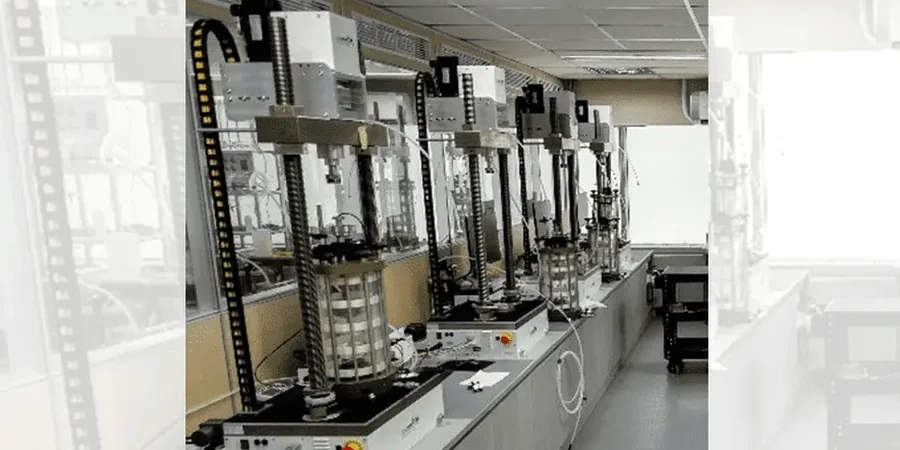
Specifying a single undrained shear strength value from a pocket penetrometer on a Montreal job site is asking for trouble. The city’s complex stratigraphy, ranging from sensitive Champlain Sea silty clays to dense glacial till, demands a solid constitutive model for any excavation deeper than a few meters. A basic unconfined compression test cannot capture the strain-softening behavior or the pore pressure response critical to short-term stability. The triaxial test provides drained and undrained parameters under controlled consolidation conditions, giving geotechnical engineers the data needed for realistic finite element analysis. For projects near the St. Lawrence River or on the island’s eastern terraces, partnering this with CPT testing helps calibrate the high-sensitivity zones before sampling even begins.
A consolidated-undrained triaxial test with pore pressure measurement reveals the true effective stress path, which often differs radically from the total stress envelope used in older Montreal foundation reports.
Service characteristics in Montreal
Critical ground factors in Montreal
Beneath the Saint-Laurent lowlands lies a marine clay deposit known for its tendency toward progressive failure. Excavations east of Papineau Avenue often result in costly shoring collapses due to inaccurate effective stress parameters. Sole reliance on UU triaxial data for total stress analysis typically overstates the factor of safety because it neglects the negative excess pore pressures generated during undrained unloading. The main danger is retrogressive landslides in this sensitive clay. A CU triaxial test with pore pressure measurement reveals the contractive behavior at large strains, which is essential for evaluating flow slide potential. When the lab reports an undrained brittleness index greater than 1.5, the design must shift from conventional cantilever walls to reinforced soil systems. Ignoring triaxial data on the saturated silt lenses within the till can cause basal heave during deep excavations in the downtown core.
Our services
The triaxial program is designed to correspond to the distinct loading scenarios of the project, encompassing rapid drawdown for riverbank stability and long-term settlement of heavy structures on compressible clay.
Consolidated Undrained (CU) with Pore Pressure
It determines the effective stress parameters c' and φ' while tracking the Skempton A coefficient at failure. This is vital for staged construction analysis on the soft deposits of the Champlain Sea.
Consolidated Drained (CD) Testing
A slow shearing rate is applied to ensure complete drainage. This test is used for the long-term stability of permanent retaining walls and bridge abutments founded on dense glacial till.
Unconsolidated Undrained (UU) Quick Shear
It offers a quick evaluation of undrained shear strength for checking short-term bearing capacity of temporary earthworks and trench stability.
Stress Path & K0 Consolidation
In-situ stress history is replicated by using anisotropic consolidation. This is an essential input for advanced numerical models that predict deformations induced by excavations near heritage structures in Old Montreal.
Top questions
What is the typical cost of a triaxial test program in Montreal?
The standard three-point CU triaxial suite on 71 mm Shelby tube samples costs between CA$2,540 and CA$3,540, depending on the consolidation stress levels and whether high clay plasticity lengthens back pressure saturation. Projects needing multi-stage triaxial or resonant column integration are quoted separately, based on the specific testing matrix.
Which triaxial test type is recommended for Champlain Sea clay?
The standard test is Consolidated Undrained (CU) with pore pressure measurement according to ASTM D4767. Due to the sensitive structure of Champlain clay, careful specimen extrusion in a controlled humidity room and back pressure saturation are required to achieve a B-value above 0.95 without disrupting the natural cementation bonds.
How long does it take to get triaxial test results?
Turnaround time is typically 7 to 10 business days after specimen trimming. The consolidation phase alone for CU tests on low-permeability silty clays can take 3 to 5 days. With continuous 24-hour monitoring on the automated data acquisition system, expedited schedules can be arranged.
Can triaxial tests simulate frost heave conditions in Montreal?
A standard triaxial cell cannot simulate freeze-thaw cycling directly. However, specialized temperature-controlled triaxial chambers can measure the shear strength degradation after multiple freeze-thaw cycles, which is particularly relevant for the upper crust of the weathered clay layer subject to Montreal's 1.4 m frost penetration depth.