Montreal sits on a complex quilt of Champlain Sea clays, glacial tills, and fluvial sands, much of it prone to settlement and—in a seismic zone rated NBCC 4—liquefaction. A project on Rue de la Commune recently hit loose saturated sand at just 3 meters depth. That is exactly where vibrocompaction design becomes the decisive step: we model the vibrator penetration grid, frequency, and duration so that relative density climbs above 70%, stabilizing the mass before foundations go in. The Island of Montreal’s variable stratigraphy demands more than generic charts; each design correlates CPT data with target SPT N-values per ASTM D6066, adapting to pockets of sensitive clay that standard deep vibro techniques would remold. For sites near the St. Lawrence River, we often pair the vibro program with a liquefaction analysis to confirm that post-densification factor of safety exceeds 1.3 under the design earthquake.
A well-designed vibrocompaction grid turns loose saturated sand into a stable, dense mat that adds bearing capacity and eliminates liquefaction risk in one operation.
Service characteristics in Montreal
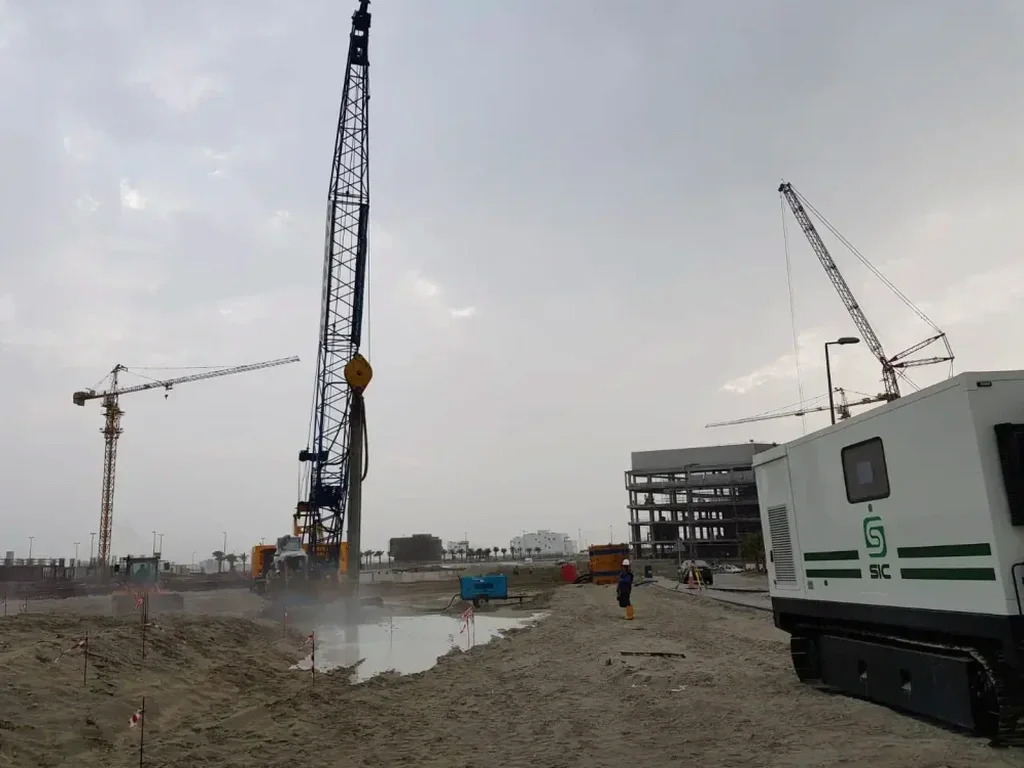
Critical ground factors in Montreal
Neglecting a pre-design CPT survey and presuming a homogeneous sand deposit is the costliest error encountered in Montreal. Loose alluvial layers mixed with silty seams respond quite differently to vibration; instead of densifying, the energy is absorbed, resulting in wasted rig hours without any progress. Another frequent mistake involves spacing the vibroflot grid excessively, which leaves untreated areas between probes that can evolve into preferential drainage paths or zones of settlement. During the design stage, we mitigate these issues by modeling spatial variability across the Saint Lawrence lowlands and adjusting probe spacing dynamically when the bottom-feed system encounters changes in resistance. We also mandate a test panel before full-scale production. In Montreal, where frost penetrates to 1.5 meters and spring thaw saturates the surface layers, incomplete compaction leads to differential heave and slab cracking within two years.
Our services
All our vibrocompaction work in Montreal spans from numerical modeling through field verification, in full compliance with Canada's National Building Code and CSA A23.3 standards for soil-structure interaction.
Grid Design and Energy Calibration
Probe spacing, vibrator power (ranging from 130 to 180 kW), and flush pressures for water or air are all selected according to grain-size distribution curves derived from Montreal's fluvio-glacial soils. Our aim is to achieve a uniform relative density of 70% to 85% throughout the treated area.
Liquefaction Mitigation Modeling
By analyzing CPT and SPT data, we perform cyclic resistance ratio computations following the Youd-Idriss (2001) method to determine the treatment depth, typically 8 to 14 meters in central Montreal. This ensures that after treatment, the cyclic stress ratio remains below the cyclic resistance ratio for the 2% probability of exceedance in 50 years.
Settlement Control for Fill and Loose Sand
When working on warehouse slabs in Anjou or logistics centers in Saint-Laurent, we engineer compaction to keep total and differential settlement below 25 mm. This is confirmed by comparing CPT readings taken before and after compaction at identical locations.
Quality Assurance and Instrumentation
During vibroflot operations, we monitor depth, amperage, and penetration rate in real time. For validation after treatment, we conduct SPT, CPT, and sometimes crosshole seismic testing to verify an increase in shear wave velocity.
Top questions
How much does vibrocompaction design cost for a typical Montreal site?
The cost for a separate vibrocompaction design (including grid configuration, energy calibration, and verification plan) falls between CA$2,180 and CA$6,550. This varies with the area to be treated, depth, and number of required CPT tests. A typical 1,000 m² site with a 10-meter treatment depth usually falls around the midpoint of this range.
Does vibrocompaction work in Montreal's Champlain Sea clay?
No. Vibrocompaction is effective in cohesionless soils—sands and gravels. Montreal’s Champlain Sea clays are sensitive and do not densify under vibration. In those zones we recommend stone columns or rigid inclusions instead. Our design always starts with a stratigraphic review to avoid applying vibration where it would remold sensitive clay and worsen settlement.
How deep can vibrocompaction improve the ground?
For Montreal's fluvio-glacial soils, our standard treatment designs extend to 12–14 meters. The actual depth limit is governed by vibrator power and soil strength; once depths exceed 15 meters, techniques such as deep soil mixing tend to be more cost-effective.
What post-treatment verification do you require?
CPT tests are required at the center of every compaction grid cell, with results directly compared to pre-treatment baseline data. For important structures, we also include SPT borings and, in some cases, crosshole shear wave velocity surveys to verify the gain in stiffness.