Designing pile foundations in Montreal requires understanding a geological patchwork that changes dramatically between neighborhoods. The limestone bedrock of the Plateau offers solid end-bearing conditions, while the deep marine clays of the East End demand friction piles that can navigate sensitive Champlain Sea deposits. This contrast within a single city means that pile design cannot follow a generic template—each site demands a custom geotechnical investigation. Our team has worked extensively across the island, from the compact glacial till underlying Ville-Marie to the organic silts near the St. Lawrence shoreline, and we integrate seismic microzonation data when the site classification influences the dynamic response of the deep foundation system.
Pile design in Montreal must reconcile the brittle limestone of the Plateau with the highly sensitive clays of the East End—two radically different foundation environments within the same city.
Service characteristics in Montreal
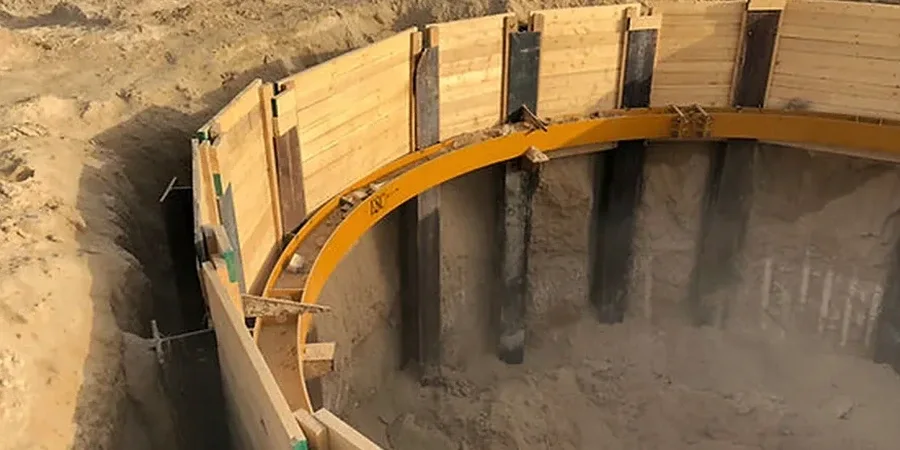
Critical ground factors in Montreal
The post-glacial soils in Montreal, combined with its severe freeze-thaw cycles, create a challenging setting for deep foundations. Extended winter periods with temperatures dropping below -20°C necessitate thermal protection measures during concrete placement for cast-in-place piles. In exposed locations, frost penetration can exceed 1.5 meters, potentially causing heave forces on pile caps unless proper isolation is provided. Sulfate concentrations present in Champlain Sea clay can degrade ordinary Portland cement; therefore, we use sulfate-resistant cement (Type HS per CSA A3001) along with increased concrete cover. In the Lachine and LaSalle regions, fills overlying the clay introduce a risk of downdrag from consolidating fills. We apply the neutral plane method to analyze this, ensuring the pile shaft's structural capacity is not exceeded by the combined dead load and negative skin friction.
Our services
From the initial geotechnical investigation to construction-phase testing and verification, our services for pile foundation design encompass every stage of the project.
Geotechnical pile capacity analysis
Axial and lateral capacities are determined through static methods (Terzaghi, Meyerhof, Vesic) and correlations from in-situ tests such as SPT N-values or CPT cone resistance, all tailored to the Champlain Sea clay and glacial till profiles found in Montreal.
Pile load test design and interpretation
We design both static and dynamic load test programs to confirm design assumptions. Strain gauge data interpretation allows us to separate shaft and end-bearing components, thereby calibrating the geotechnical model.
Construction-phase foundation engineering
To ensure constructed elements meet design intent under Montreal's variable subsurface conditions, we provide pile driving criteria, inspector support, and review of pile installation records.
Top questions
What type of pile is most suitable for the Champlain Sea clay in Montreal?
Driven steel H-piles and precast concrete piles are frequently used to penetrate the clay and reach competent bearing strata. When thick clay deposits make end-bearing impractical, large-diameter bored piles or continuous flight auger piles rely on skin friction for capacity. However, careful management during installation is required due to the clay's remolding sensitivity.
How much does pile foundation design cost for a typical Montreal project?
For a typical residential or small commercial project in Montreal, the cost of the geotechnical investigation and pile design package generally falls between CA$2,630 and CA$7,880. The actual amount depends on factors like the number of borings, soil profile complexity, and whether load testing is included.
Do you account for Montreal's seismic requirements in pile design?
Yes, we incorporate Montreal's seismic hazard values from the NBCC 2020, including amplification effects based on site soil class. The lateral load analysis evaluates the pile-to-cap connection, pile section ductility, and potential liquefaction in loose granular layers.
What information do you need to start the pile design process?
We require structural loads (axial, lateral, and moment), the proposed building footprint, and a geotechnical site investigation with boreholes extending at least three pile diameters below the expected tip elevation. If existing borings from Montreal's municipal archive are available, we can review them to determine if additional investigation is necessary.