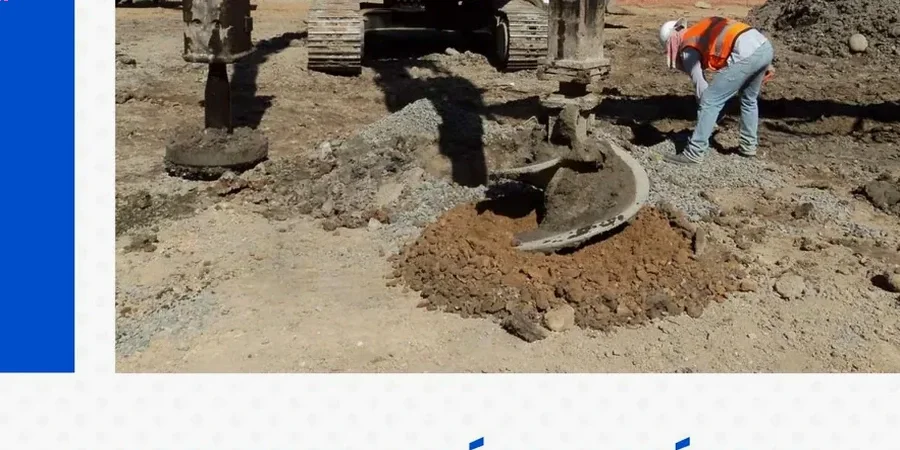
A few years ago, we were called in on a warehouse project off Rue Jarry, right over the old clay beds that make Montreal's east end such a challenge. The geotech report showed nearly 10 meters of soft, sensitive silty clay—the kind that loses strength if you just look at it wrong. The structural loads called for a bearing capacity that the natural ground simply could not deliver, and conventional over-excavation would have been an open-pit nightmare given the high water table. We proposed a stone column design using the vibro-replacement method, which allowed us to reinforce the native soil in place and keep the schedule on track through an unusually wet October. In Montreal's post-glacial geology, where Champlain Sea clays dominate the subsurface, a well-executed stone column grid is often the most practical path to a stable foundation. When we kick off a design, we usually pair our investigation with CPT testing to get a continuous strength profile and verify that the clay sensitivity won't spike during column installation. The shear wave data from a MASW survey also helps us confirm that the improved composite ground will meet the site class requirements under NBCC for seismic performance in eastern Canada.
In Montreal's Champlain Sea clays, a stone column grid doesn't just carry the load—it forces the excess pore pressure to dissipate radially, accelerating primary consolidation by a factor of three or more.
Service characteristics in Montreal
Critical ground factors in Montreal
The National Building Code of Canada 2015 (NBCC) and CSA A23.3 place explicit requirements on the allowable bearing pressure and total and differential settlement of foundations, and in Montreal's seismic environment—where the design spectral acceleration Sa(0.2) can exceed 0.6 g in parts of the city—post-improvement ground performance under cyclic loading is a non-negotiable check. A stone column design that only addresses static settlement but ignores the potential for pore pressure buildup during a design earthquake leaves the owner with a hidden liability. The low-permeability Champlain clay matrix does not drain quickly during shaking, so we must verify that the densified column network will prevent liquefaction of the inter-column soil and avoid a sudden loss of foundation stiffness. We also evaluate the bulging failure mode in the upper two to three column diameters, which is the critical depth where lateral confining stress is lowest. During a 2021 remediation project in the Villeray district, we discovered that an earlier, poorly documented stone column installation had used an undersized aggregate that had partially migrated into the surrounding silt, effectively halving the design stiffness—a defect that only became visible when we ran in-situ permeability tests and compared the results to the original design intent.
Our services
In the Montreal area, our stone column design methodology is tailored to address the distinct difficulties posed by post-glacial soil formations, encompassing a full suite of services from initial subsurface exploration to ongoing installation oversight.
Design of Vibro-Replacement Grids
We conduct thorough analytical and numerical modeling for stone column layouts to enhance bearing capacity and mitigate settlement, employing both Priebe's method and finite element analyses, all calibrated to the unique properties of the local Champlain Sea clay.
Load Test and Quality Control
Performance verification includes overseeing modular load assessments on individual stone columns and zone tests on column groups, accompanied by settlement monitoring and subsequent back-analysis to validate the stress concentration ratio and composite modulus prior to pouring structural concrete.
Seismic Performance Verification
We perform cyclic triaxial tests on the stone backfill material and carry out post-installation CPT or SPT checks to confirm that the enhanced ground satisfies NBCC site class criteria and removes the danger of liquefaction in the soil between columns.
Top questions
What is the typical cost range for a stone column design package in Montreal?
A thorough design package—encompassing site investigation evaluation, analytical modeling, construction specifications, and installation supervision—is generally priced between CA$1,920 and CA$7,630. The exact amount varies based on soil profile complexity, number of column clusters, and whether seismic performance checks and load tests are part of the scope.
How do you verify that the stone columns are actually working after installation?
Our approach integrates post-installation CPT soundings that penetrate both the inter-column soil and the stone column itself, modular plate load tests on individual columns, and extensive zone tests featuring multi-point settlement monitoring. The CPT results are compared with pre-design soundings to quantify the increase in tip resistance and the reduction in pore pressure dissipation duration.
Can stone columns be installed inside an existing building with limited headroom?
This is achievable but demands careful coordination. We have engineered low-headroom installation sequences using bottom-feed vibroflots that function with under 4 meters of vertical clearance, although the production efficiency decreases notably. Stone delivery and power pack access must be arranged, and we typically opt for a smaller aggregate size to suit the compact equipment.
What is the difference between vibro-replacement and vibro-compaction in your designs?
Vibro-replacement creates dense stone columns that reinforce soft cohesive soils by substituting a part of the weak matrix, whereas vibro-compaction tightens existing granular soil without introducing fill. In Montreal, most projects necessitate vibro-replacement because the Champlain Sea clays and silts have insufficient fines content for densification alone—they require the load-bearing framework that stone columns supply.