The most common mistake we see on Montreal sites is treating a retaining wall as a standard structural element without accounting for the Champlain Sea clay. A contractor will pour a textbook cantilever wall, only to find it tilting toward the excavation within two freeze-thaw cycles. The problem is rarely the concrete mix; it is the assumption that the backfill behind the wall will behave as a drained, frictional material. In reality, much of central and eastern Montreal sits on sensitive marine silt and clay deposits that lose strength when disturbed, and pore pressure buildup behind even a well-drained wall can exceed design assumptions by 30%. Our team approaches retaining wall design by first mapping the stratigraphy with test pits to identify the depth to till or bedrock, then matching the wall type to the actual earth pressure envelope the soil will deliver over a 50-year service life.
Montreal’s Champlain Sea clay does not forgive shortcuts: get the earth pressure diagram wrong by 15%, and you’ll be rebuilding the wall in five years.
Service characteristics in Montreal
Critical ground factors in Montreal
For most retaining wall design investigations in Montreal, we deploy a truck-mounted geotechnical drill rig that uses hollow-stem augers and Shelby tube samplers. In confined back-lane areas typical of Rosemont or Villeray, we switch to a compact track-mounted unit that can fit through a 1.8-meter gate. Continuous sampling is conducted through the proposed wall footprint until refusal is encountered on till or bedrock, which on the island can range from 3 to 20 meters deep. Each Shelby tube is sealed on site to retain the natural water content of the sensitive clay; if a sample dries out during transport, the liquidity index changes and the lab-derived strength values become unreliable. Standpipe piezometers are also installed behind the planned wall alignment to measure the static groundwater level over at least one full seasonal cycle. Walls constructed without this data often suffer from undersized drainage systems because the designer assumed a water table two meters lower than what actually occurs during the spring thaw when frozen ground traps surface infiltration. The cost of a single monitoring standpipe is negligible compared to the expense of excavating and rebuilding a failed wall that has displaced 150 millimeters at the top.
Our services
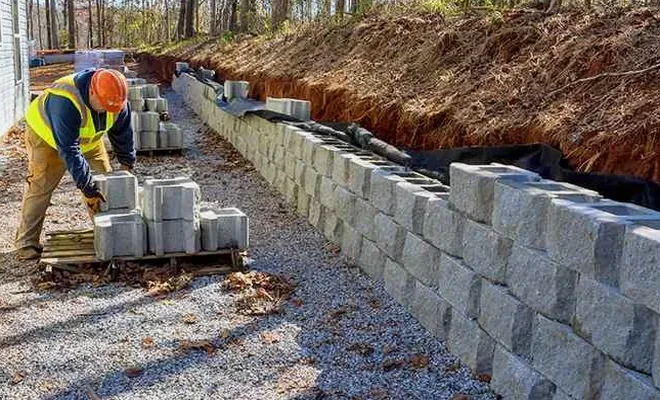
Retaining wall design in Montreal ranges from simple segmental block walls for residential landscaping to 8-meter cast-in-place cantilevers supporting arterial roads. We customize each investigation based on the wall's consequence of failure.
Permanent cantilever and gravity wall design
Our complete geotechnical design package includes bearing capacity checks, global stability analysis using limit-equilibrium software, and drainage specifications for walls up to 10 meters exposed height. We provide signed and sealed reports that are accepted by all Montreal borough engineering departments.
Temporary shoring and excavation support
For construction-phase excavations, we design soldier pile and lagging walls, sheet pile cofferdams, or soil nail systems. We address Montreal's specific requirement for freeze-thaw protection of exposed cuts left open through winter months, which is often overlooked in generic shoring designs imported from milder climates.
Top questions
What is the typical cost range for a retaining wall design in Montreal?
For a permanent retaining wall on a single-family residential lot, the geotechnical investigation and design package typically costs between CA$1,400 and $5,340, depending on the number of boreholes required and the wall height. Larger commercial walls or those supporting public infrastructure involve additional analysis and higher fees; we provide a fixed-price proposal after reviewing the site address and preliminary grading plan.
Do Montreal boroughs require a geotechnical engineer to stamp retaining wall drawings?
Every Montreal borough we work with requires a signed and sealed geotechnical report for retaining walls over 1.2 meters in exposed height. Some boroughs, such as Ville-Marie and Côte-des-Neiges–NDG, also require the report to address the impact of the excavation on adjacent properties, including vibration monitoring thresholds if rock removal is anticipated.
How do you handle retaining wall design on Champlain Sea clay?
We conduct consolidated-undrained triaxial tests with pore pressure measurement to determine the effective stress strength envelope of the clay, then perform both short-term (undrained) and long-term (drained) stability checks. The design almost always includes a continuous drainage blanket behind the wall and a solid toe drain to prevent hydrostatic pressure buildup. In highly sensitive zones, we evaluate the risk of progressive failure triggered by construction vibrations and may specify low-vibration compaction methods within the setback zone.
What is the turnaround time for a retaining wall design report in Montreal?
The laboratory analysis phase for clay specimens, which encompasses consolidation and triaxial testing, generally requires about three weeks after the field work is completed. Once the client has provided final approval on the wall alignment and grading plan, the completed and signed report is issued between four and five weeks from the drilling date. For projects with urgent construction timelines, a faster report delivery in two weeks is possible for an additional cost.