In Montreal, in-situ testing is the cornerstone of geotechnical site characterization, relying entirely on field-based techniques to assess soil, rock, and groundwater conditions without extracting samples for lab analysis. This suite of methods—ranging from penetration tests and geophysical surveys to permeability and density measurements—provides instant data on subsurface behavior under ambient stress. Given Montreal's foundation on intricate glacial and post-glacial deposits, where infrastructure must navigate sensitive marine clays, uneven bedrock depths, and aggressive freeze-thaw cycles, in-situ testing yields crucial parameters for designing foundations, analyzing slope stability, and planning excavation support. The real-time insights allow engineers to dynamically refine investigation programs, pinpointing problematic zones that discrete sampling alone could miss.
Montreal's unique geology makes in-situ testing absolutely vital. Most of the island sits atop Champlain Sea sediments deposited 13,000 to 10,000 years ago, forming thick silty clay layers with notable sensitivity and thixotropy. These soils dramatically weaken when disturbed—a trait often hidden by conventional sampling but directly captured through field vane testing and cone penetration testing (CPT). Underneath, the sedimentary bedrock, primarily limestone, shale, and sandstone from the Lorraine, Utica, and Trenton groups, varies sharply in depth and quality, creating abrupt changes that demand continuous profiling. Moreover, high groundwater levels influenced by the St. Lawrence and Ottawa Rivers pose hydrostatic challenges that in-situ pore pressure measurements and permeability tests address with far greater accuracy than lab methods.
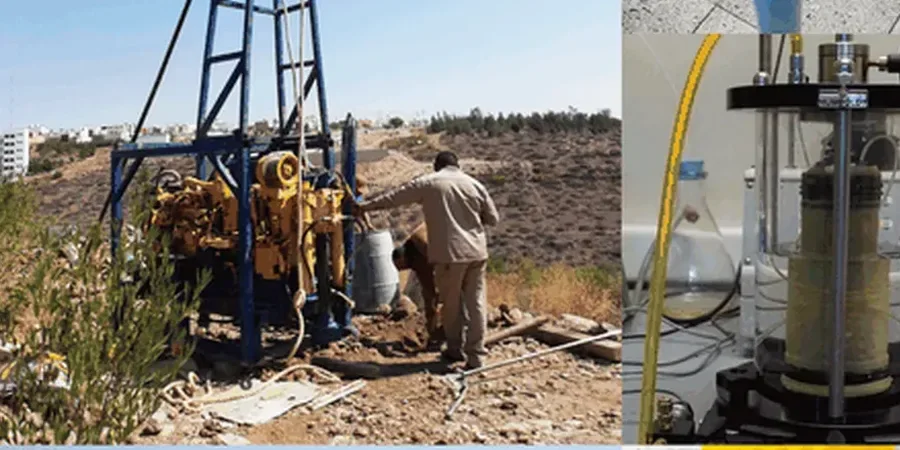
All in-situ work in Montreal follows Canadian standards from the Canadian Foundation Engineering Manual and relevant CSA Group specifications. The Bureau de normalisation du Québec (BNQ) mandates compliance with ASTM and CSA test methods, including CSA A23.2 for concrete testing, CAN/BNQ 2501-250 for geotechnical site investigations, and ASTM D1586 for standard penetration tests. For environmental assessments, MELCCFP protocols apply when in-situ testing involves contaminated materials. Practitioners must also adhere to Ordre des ingénieurs du Québec guidelines, requiring that field tests be overseen by qualified engineers who can interpret results within Quebec's regulatory framework.
The range of projects requiring in-situ testing across the Montreal metropolitan area spans virtually every construction sector. Major infrastructure initiatives like the Réseau express métropolitain light rail system relied heavily on CPT and pressuremeter testing to design deep foundations through variable glacial till. High-rise developments in downtown Montreal and Griffintown routinely employ cross-hole seismic testing and field density test (sand cone method) procedures to verify compaction of engineered fills above compressible native soils. Industrial facilities in the East End's petrochemical corridor require in-situ permeability assessments for secondary containment compliance, while municipal projects addressing aging combined sewer overflows depend on in-situ infiltration testing to design stormwater management systems. Roadway reconstruction, bridge abutments, and slope stabilization along the city's escarpments all begin with field-derived strength and deformation parameters.
Available services
Questions and answers
What distinguishes in-situ testing from laboratory testing for Montreal projects?
In-situ testing captures soil and rock properties under natural stress, moisture, and temperature conditions without disrupting the material's structure. This is especially important in Montreal's sensitive Champlain clays, which lose strength when sampled and transported. Field methods such as CPT and vane shear testing reveal true in-place behavior, including pore pressure response and stratigraphic continuity, whereas lab tests on disturbed samples may underestimate settlement potential or overestimate strength in these deposits.
Which in-situ tests are most commonly required for foundation design in Montreal?
Standard penetration testing remains common for initial assessments, but cone penetration testing with pore pressure measurement has become vital for deep foundation designs in Montreal's variable soils. Pressuremeter tests supply modulus and limit pressure data for lateral pile analysis, while field vane testing directly measures undrained shear strength in sensitive clays. Cross-hole and down-hole seismic methods supplement these when shear wave velocities are required for seismic site classification per the National Building Code of Canada.
How do Quebec regulations affect in-situ testing procedures and reporting?
Quebec's professional engineering regulations stipulate that all in-situ testing must be supervised or directly performed by an engineer licensed with the Ordre des ingénieurs du Québec. Testing methods must follow recognized standards like ASTM or CSA, with BNQ offering additional provincial guidance. Reports must include interpretations by qualified professionals, and for contaminated sites, work must align with MELCCFP protocols. Borehole and test location plans require surveying tied to provincial coordinate systems for integration into municipal permit submissions.
What seasonal considerations affect in-situ testing in Montreal?
Montreal's severe winters significantly affect the scheduling and methodology of in-situ testing. Frozen ground can impede CPT and SPT penetration until pre-drilling or thawing occurs, while snow cover complicates access and site layout. Spring thaw results in saturated, weakened near-surface soils that demand careful equipment support. Many projects accelerate field programs between May and November, though winter testing is possible with proper preparation, such as heated enclosures for sensitive instruments and tracked vehicle access for drill rigs.