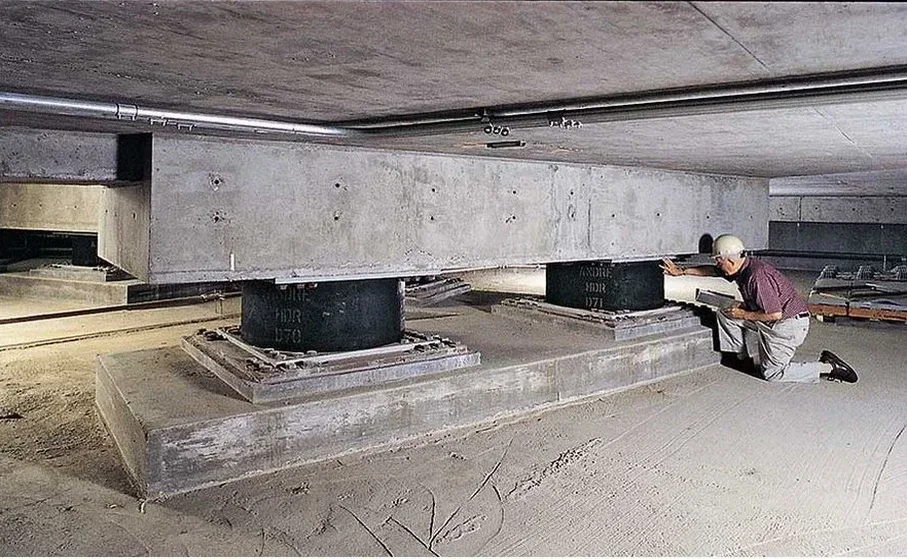
The soil profile changes dramatically between downtown Montreal and the eastern boroughs. In Ville-Marie, you might hit compact glacial till within three meters, while over in Hochelaga-Maisonneuve or the eastern Plateau, the Champlain Sea clay extends 20 to 30 meters deep with sensitivity ratings that make any geotechnical engineer pause. A conventional fixed-base structure sitting on that sensitive clay amplifies seismic waves straight into the frame. Base isolation seismic design flips the problem on its head. Instead of forcing the building to fight the shaking, we decouple it from the ground motion entirely. The isolators absorb the displacement while the superstructure stays level. For a city like Montreal, where the seismic microzonation maps show distinct response spectra in less than two kilometers, this approach makes structural and financial sense. We have seen projects on Sherbrooke Street where isolating the base reduced the design base shear by over 60 percent compared with a fixed-base scheme under the same NBCC 2020 site class.
In Montreal's Champlain clay basin, base isolation can cut the design base shear by more than half while keeping the superstructure elastic under the 2% in 50-year event.
Service characteristics in Montreal
Critical ground factors in Montreal
We set up the testing rig with a 10,000 kN vertical actuator and a ±500 mm horizontal stroke. The machine runs on a servo-hydraulic loop that can replicate the velocity pulses recorded in the Charlevoix seismic zone, the source that dominates Montreal's hazard deaggregation. A lead-rubber bearing that looks perfect on the specification sheet can lose 20 percent of its energy dissipation capacity after just three cycles at MCE displacement if the lead core overheats, something you only catch in a full-scale dynamic test. The Champlain clay adds another layer: consolidation settlement under the isolator pedestals can tilt the bearings and reduce their lateral capacity. We model that coupled behavior with the deep excavation and foundation data before finalizing the isolation parameters. Skipping that step in Montreal means you are betting the building's seismic performance on an assumption, not a verified condition.
Our services
In Montreal, we offer two base isolation service packages, each based on lab testing of devices and local geotechnical conditions.
Nonlinear Time-History Analysis & Isolator Specification
Our team creates complete NLTHA models in ETABS or Perform-3D, employing ground motion suites calibrated to Montreal's NBCC 2020 uniform hazard spectrum. The deliverables consist of the isolator's force-displacement backbone, a stability verification under MCE loading, and a procurement specification sheet.
Full-Scale Isolator Testing & Quality Control
In our ISO/IEC 17025 accredited facility, we conduct prototype and production tests per ASCE 7-22 Section 17.8, including cyclic shear, aging, creep, and ultimate displacement capacity. Every bearing receives a unique digital certificate prior to shipment to the Montreal location.
Top questions
Does base isolation work on the soft Champlain clay common in Montreal?
That is correct, and it is frequently the optimal option. Soft clay increases long-period motion—precisely what a fixed-base mid-rise building should evade. Base isolation moves the building's period beyond the amplification zone. We validate soil-isolator interaction using site-specific CPT and shear wave velocity profiles to ascertain effective damping and displacement requirements.
What is the typical cost range for base isolation design and testing on a Montreal project?
For a medium-scale structure, the total cost for design, analysis, and lab testing generally ranges from CA$6,150 to CA$11,870, based on how many isolator types are involved and the complexity of the ground motion suite.
How does the NBCC 2020 treat base-isolated structures compared with conventional ones?
NBCC 2020 incorporates ASCE 7-like provisions for isolated buildings, permitting a reduced response modification factor R if the isolation system has been appropriately tested and the superstructure stays nearly elastic. The essential point is to show via prototype testing that the isolator fulfills minimum lateral restoring force and stability criteria under MCE displacement.