The subsurface conditions in Montreal are more critical than its 47-meter elevation above the St. Lawrence River. With a population exceeding 1.7 million on an island characterized by Champlain Sea clay and dense glacial till, proper compaction control is essential—preventing differential settlement during freeze-thaw cycles that see temperatures drop below -20°C. The Proctor test (Standard or Modified) serves as our primary defense against such issues. We routinely perform both ASTM D698 and ASTM D1557 because Montreal's post-glacial soils vary from stiff silty clay in Ville-Marie to bouldery till in the West Island; a single moisture-density relationship rarely applies even to adjacent sites. Achieving the correct maximum dry density and optimum moisture content before any structural fill is placed eliminates months of costly rework.
A Proctor curve is not just a number on a report; it is the compaction fingerprint of the exact borrow source your crew is placing today.
Service characteristics in Montreal
Critical ground factors in Montreal
A prevalent error in Montreal involves contractors applying Standard Proctor to granular borrow for high-traffic sub-bases, then observing pavement deflection after two winters. Freeze-thaw cycles in the island's silty sands cause upward migration of fines when the compacted layer lacks Modified Proctor energy. Another expensive oversight is failing to adjust for the difference between laboratory optimum moisture and the actual moisture content of stockpiled fill in October, when rainfall and early frost push water content beyond acceptable limits. Compacting Champlain Sea clay wet of optimum traps pore pressure that releases during spring thaw, resulting in soft spots under foundations. Additionally, imported granular fill from quarries north of Laval often contains mica that skews the Proctor curve; without a project-specific curve, field density tests yield false positives and wasted compaction effort.
Our services
A Proctor test alone provides density targets, but a comprehensive compaction control program in Montreal links lab curves to field performance. We integrate these services to ensure fill placement is verified from start to finish.
Standard Proctor (ASTM D698)
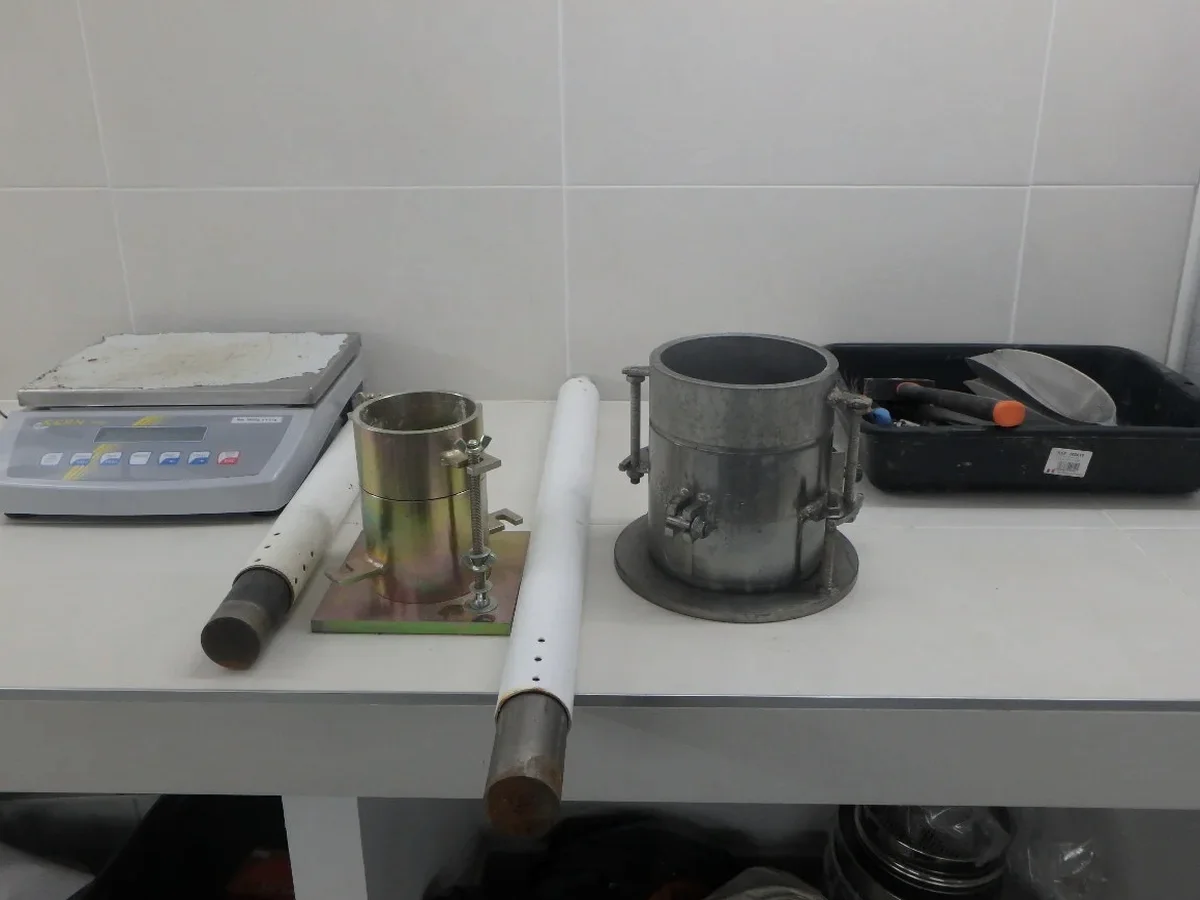
For backfill around residential foundations, utility trenches in low-traffic areas, and landscaping berms with moderate compaction effort, we employ the Standard Proctor method using a 5.5-lb hammer. The resulting moisture-density curves typically target 95% of maximum dry density for cohesive fills in Montreal's residential districts.
Modified Proctor (ASTM D1557)
Highway embankments, commercial building pads, and heavy industrial floor slabs across the island require Modified Proctor. This higher compactive effort aligns with large vibratory rollers and sets a realistic benchmark for granular material from Laurentian quarries.
Field Compaction Verification
Laboratory Proctor results are only effective when verified by field density testing. At active sites—from Turcot Interchange backfill to residential garage pads in Saint-Laurent—we use nuclear gauges and sand cone methods to ensure placed fill meets the specified percentage of the lab-determined maximum dry density.
Top questions
What does a Proctor compaction test cost for a typical Montreal residential project?
The cost for a Standard Proctor curve with moisture-density relationship on typical borrow material ranges from CA$140 to CA$270, depending on whether a one-point verification or a full five-point curve is needed. Modified Proctor falls at the higher end due to additional preparation and compactive effort.
When should we choose Modified Proctor over Standard Proctor in Montreal?
Modified Proctor is suitable when fill will support heavy structural loads or high-traffic pavements, and when compaction equipment involves large vibratory rollers. For most residential backfill and low-rise foundation pads in Montreal, Standard Proctor provides an adequate and realistic target; however, projects referencing MTQ or NBCC specifications for commercial work should default to Modified.
How does Montreal's Champlain Sea clay affect the Proctor curve?
The Champlain Sea silty clay is highly sensitive to molding water content. Our laboratory carefully examines the curve's wet side because compacting this material more than 2% above optimum can trap pore pressure that does not dissipate before freeze-up. The wet side typically shows a steeper drop in dry density than in till, necessitating tighter field moisture control tolerances.
Can you reuse a Proctor curve from a previous phase of the same Montreal project?
Only if the borrow source and the gradation have not changed. We recommend running at least a one-point verification against the original curve whenever a new stockpile is opened or the material visually shifts. Montreal's quarries can vary within the same pit, and even a 5 percent change in fine content shifts the optimum moisture enough to invalidate an old curve. More info.